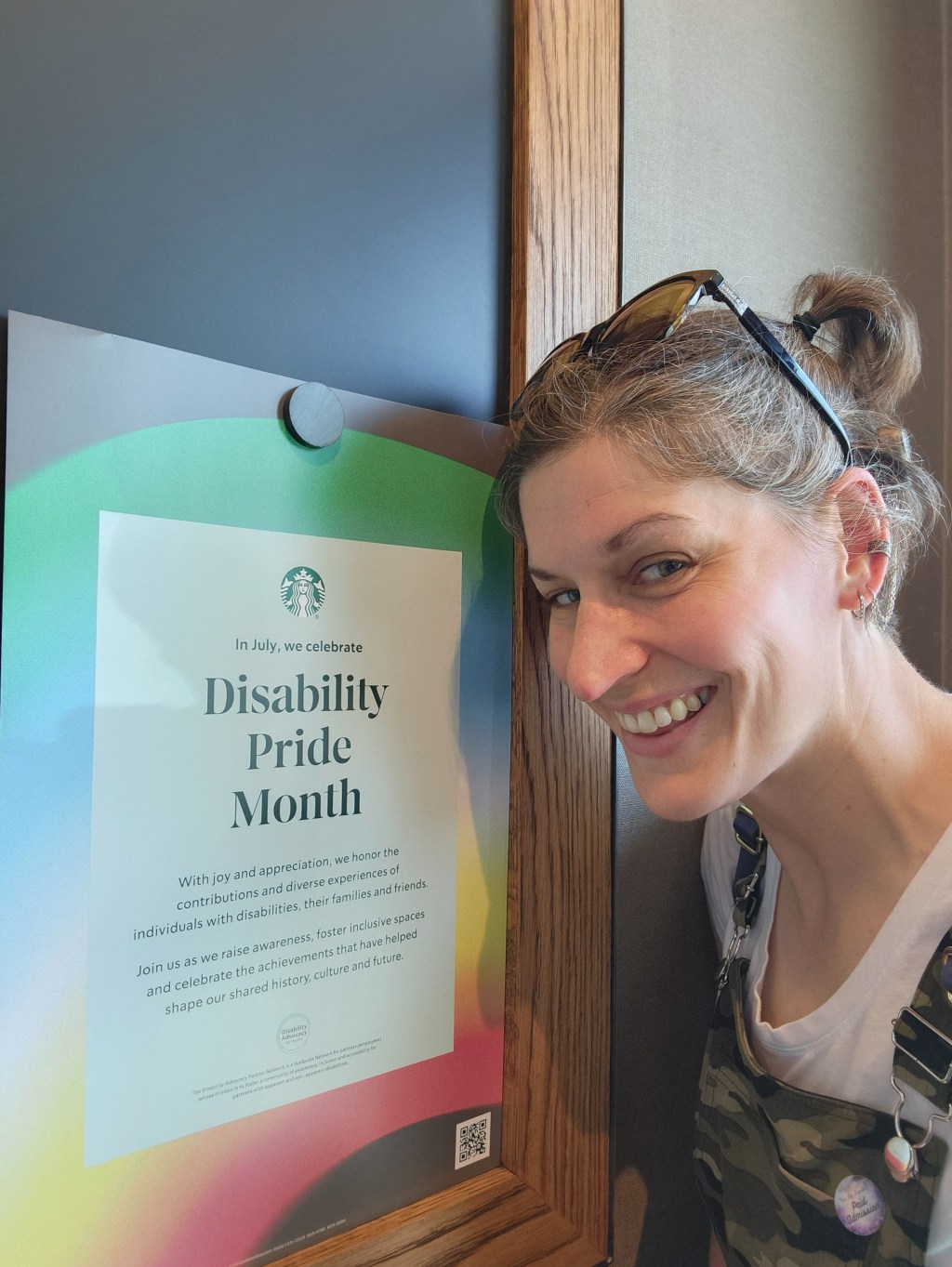
I was not aware of Disability Pride Month until this year – and now it feels like I’m seeing it all over! It first came to my attention at a Starbucks, of all places; and even though I’ve often felt like Starbucks could really do more to accommodate those with hearing loss, I definitely felt unexpectedly welcomed. They even had special edition mugs and cups with artwork celebrating and created by local people with disabilities, which I found very cool.
Then, I ran into this excellent infographic to explain the Disability Pride Flag. I had not been aware of the meaning behind it. I guess I get to celebrate twice as hard, as I can fall into both the invisible and sensory disabilities categories with my hearing loss and brain tumor survivor cred.

These experiences got me thinking about how I feel about being a person with a disability. I know some people really dislike or resist the label. I think that is a totally understandable choice, and I believe each person should decide how they want to label themselves. I choose to call myself a person with a disability. To me, admitting I have a disability doesn’t make me less. In some ways, it feels somewhat freeing. I don’t have to pretend that I can do and handle every single situation. Sometimes, I need accommodations, or certain things are just not a fit for my needs. It helps me remember to take steps to plan things to increase my odds of success and reminds me to lean into assistance devices and coping mechanisms. I have a tendency to push myself hard, I need to remember I am not, in fact, Superman. It’s been good for my quality of life to come to a place where I love and accept my very imperfect body.
I definitely identify a lot with the moniker, invisible disability. I am consistently having conversations with people where they are shocked to learn I have a disability. Even when I recently attended the Hearing Loss Association of America’s convention, where the vast majority of attendees had hearing loss, I found many people assuming I was a hearing loss professional rather than a person with hearing loss. I have been told I don’t sound like I have hearing loss. I have been told I don’t look like I had brain surgery. I think this just shows how important it is to educate people. I am exactly what a person with hearing loss and what a brain tumor survivor looks like. I hope that sharing my story helps people be more understanding and make fewer assumptions in future interactions with others.
I have also found lately that working to make my hearing loss more visible has been in my favor. I have been wearing my hair up a lot at work, which displays my bone anchored hearing aid, and it has led to many great conversations where people have questions about my hearing device or want to connect because they have hearing loss too. I am delighted that showing off my hearing device is helping connect me to more people with hearing loss, and also that I can then share information and resources with them. Someone told me that their twelve year old daughter was so excited to see that I wore hearing devices like her. I love helping others feel less isolated. I also find that disclosing my disability can help smooth the way for me.
I recently flew by myself, and I wore a hard of hearing name tag (which I always do, especially when I travel solo). For the first time, a ticket agent noticed, and she asked if she could add it to my boarding pass. I said sure. She then proceeded to give me pre-boarding. Now, I didn’t especially need the pre-boarding. However, it was nice to have as I was flying Southwest, and by pre-boarding, I could be certain to get a seat where no one was on my deaf side. That made for a much less stressful flight. So often I think I CAN do it, so I should. But honestly, I don’t always have to take the most challenging route. I can accept the assistance of others and make my path easier.
It’s all a very personal choice, but I think there is a lot of good in being open about disabilities. It can make things better for you, as well as for others struggling with similar situations. Regardless of how you choose to label or celebrate your abilities, I hope you use all the reminders this month as a call to love your imperfect self.
ameridisability.com/how-to-display-disability-pride/

 The "Lucky" Brain Tumor
Leave a comment