

This story is told by NK regarding their experience of receiving Gamma Knife radiosurgery. NK kindly reached out to me and offered to share their story. As I have no experience of receiving radiation personally, I was very excited for the opportunity to share this story. I have been a caregiver for someone who received radiation on their brain, but I did not have that treatment myself. People reach out to me frequently looking for stories of others who had radiation as a young adult. NK does a wonderful job describing their experience.
“My acoustic neuroma journey has been long and very complex, and I hope to share it in a separate blog one day. In the meantime, I’m so grateful to Emily for the opportunity to share some of my experiences on her lovely blog.
Today is the 4-year anniversary of my tumor diagnosis, an emotional day which I try to commemorate every year with an act of positivity. This year, I’m sharing my own experiences with gamma knife radiation treatment following my second brain surgery after tumor re-growth. I hope to help anyone in the same scary, lonely, and confusing situation I was in to feel less alone and more informed.
I know how difficult and isolating this experience is, so if anyone has questions (about radiation, second surgery, re-growth, etc.) please feel free to reach out at terminatetoby@gmail.com!
A brief background:
I was diagnosed with my tumor (~3.6cm), not-so-affectionately nicknamed “Toby”, in January 2021 when I was 31 years old. I had hit my head and because I had severe hydrocephalus, everything became really bad really fast. I had tumor resection surgery via translab approach very shortly after my diagnosis at the beginning of February 2021. Unfortunately, I lost all hearing in my left ear as a result of the surgery. After surgery, I experienced many common symptoms associated with tumor resection: balance issues, facial palsy, facial weakness, and synkinesis. However, with the guidance of great physical therapists who specialized in vestibular PT and facial nerve function and with a lot of hard work, I saw significant improvement over a few months and was able to return to work by May.
Unfortunately, I later developed several symptoms not commonly associated with acoustic neuroma surgery. I had severe and localized facial pain that felt like a constant burning on my face, and significant facial spasming. The tinnitus in my left ear intensified to a loud and painful buzzing almost like I had wasps in my ear and felt worse whenever I turned my head. Over time, I also developed intense headaches and my balance issues started deteriorating again.
Despite these worsening symptoms, my neurosurgeon kept telling me that everything was “probably fine”—but I could tell in my own body that something felt wrong. By early 2022, an MRI confirmed what I felt: my tumor had re-grown almost to its original size. After speaking with several doctors who were concerned with how quickly the tumor had fully re-grown, it was clear that the best course of action was to have another surgery to reduce the tumor size, followed immediately by radiation to stop tumor growth.
In October 2022 I had a second brain surgery by suboccipital approach, and in December 2022 I had gamma knife radiation. I was extremely anxious for radiation in large part because I didn’t have a great idea of exactly what to expect that day or during the recovery period. Below is my own experience with gamma knife radiation, which I hope can alleviate that anxiety for others.
Prepping for the Procedure:
My anxiety was at an all-time high before the procedure, and in the month leading up to it, I focused on self-care activities to make sure that I went into the procedure in the best mental headspace. While hard to prioritize, I think it was really vital to focus on my mental health before treatment to help alleviate the stress and anxiety. I also looked for resources to give me an idea of what to expect. I found that the video below from Princess Margaret Cancer Center gives a good walkthrough of what my day looked like, although in my case I had an MRI rather than a CT scan for the planning stages.
Headframe installation:
The first big step on the day of the procedure was the installation of the headframe. The doctor numbed the locations where they would insert the pins in my forehead and the back of my head with local anesthetic (similar what the dentist would use). They then fastened the headframe, which had 4 “pins” or screws, onto my head at these 4 locations. I experienced a lot of pressure at the 4 pin points where the headframe went into my head and a persistent ache around my whole head — almost like a tension headache. There wasn’t any medication they could provide that helped with this. I hadn’t expected any pain at all as I thought I would get enough anesthesia to make me feel totally numb; instead, I felt like my head was captured in a vice and being crushed.
As expected, the headframe itself was really uncomfortable. Below is an illustrated version of my face with a picture of the actual headframe on it. It felt almost like there was a cage around my whole head. I’m not usually claustrophobic, but this definitely made me feel closed in and uncomfortable, especially because I was wearing a face mask.

Initial MRI and Waiting in a Headframe:
Once the headframe was installed, my doctors took an initial MRI scan to determine the radiation plan. This took ~30 minutes, and felt like a typical MRI except for the uncomfortable headframe.
After the MRI, I was sent to wait in a room while the doctors determined the radiation plan. I waited with my friends, who brought me snacks and did their best to distract me with stories of their alternately funny and dramatic experiences acquiring tickets to the Eras tour. Spending this time with my friends was the best way to keep from spiraling into anxiety while I waited – as always, they were there for me when I needed them.
Still, the 2-hour wait was the hardest part of the entire day for several reasons:
- The headframe made it feel like my head was in a cage; I could barely move and felt trapped.
- I felt like I couldn’t rest because of the headframe. I couldn’t lean my head back on the chair and just had to sit upright the whole time.
- By this point, my head hurt a lot from the pressure of the headframe at the insertion points. The headache and pressure made me feel dizzy if I tried to turn or move my head at all.
- My neck became totally stiff and hurt a lot from holding up more weight than it was used to.
- In hindsight, I wish I had brought a travel pillow or used a heat pack to help reduce the stress on my neck
- I knew I’d be getting radiation soon and I had really high anxiety as I anticipated the procedure.
Radiation Treatment:
After about 2 hours of waiting, the doctors brought me into the room for the radiation treatment. They had me lie down and secured the headframe to the table so that the radiation was delivered precisely to the tumor. Although the procedure mostly felt like an MRI, knowing that my head was bolted down somehow made the machine feel even more claustrophobic. Thankfully, the procedure took only half an hour for me due to the size and location of my tumor.
During the procedure, I felt a lot calmer since the anticipation was over and I was able to get myself to relax inside the machine. After the treatment, the headframe was removed and after a short rest in the hospital, I was discharged — no special instructions other than to rest and to hydrate.
Post-Radiation:
Immediately after the treatment, I was slightly dizzy and really tired, so I needed to sleep as soon as I got home. I felt nauseous and couldn’t eat for a few hours, but I got my appetite back pretty quickly. My incisions healed normally and left minimal scarring, but I had an awful headache for almost a full week. I also felt incredibly tired and wanted to sleep a lot during that week. Although I stayed home from work, I did feel okay performing my other routine activities, albeit slightly slower than usual.
Before radiation, my doctors had assured me that I would feel better in “2-3 days, 1 week at most”.
Reader, this was not the case. While my scars were healed and I was back on my feet, I felt extreme fatigue for several months. I was so tired after work each day that I had to take a 30-minute nap, which I hadn’t even needed after either of my two surgeries. To this day, I still experience awful headaches and fatigue and am often frustrated by how quickly I become tired.
Perhaps the toughest side effect is that my tumor became “swollen” due to the radiation. This “tumor swelling” is a known radiation after-effect, and my neurosurgeon anticipates that it will take about 3 years from radiation for the swelling to decrease. In my case, the remaining tumor is unfortunately next to my trigeminal nerve, which is responsible for sending pain signals to the brain. The “swollen” tumor is likely compressing this nerve, resulting in severe facial pain focused in the jaw/mouth. I also suffer from persistent facial spasming, although the exact cause for this symptom is less clear. While “tumor swelling” is common, my doctors have said facial pain and spasming are rare and are most likely due to my tumor’s location and size and are not a direct result of radiation treatment.
Still, the facial pain and facial spasming are excruciating and ever-present and have made some of the joys of life—eating, talking, even smiling—really difficult. However, I have worked hard to develop strategies to fight through the pain because having a normal, joyful life is really important to me. I cherish experiences like talking and joking with friends over a meal, even if it requires spending time doing painful facial PT stretches beforehand. The moments where I can share a laugh with my friends and forget about the pain have often been my best medicine. While I have experienced relatively rare and extremely difficult side effects, I’m working to meet the challenge of accepting and integrating this new reality and live my life as well as possible.
I’m two years out from radiation at this point, and Toby the Tumor still showed a necrotic core (dead cells at its center) on my last MRI. Here’s hoping that he stays that way for the rest of my life.
Epilogue:
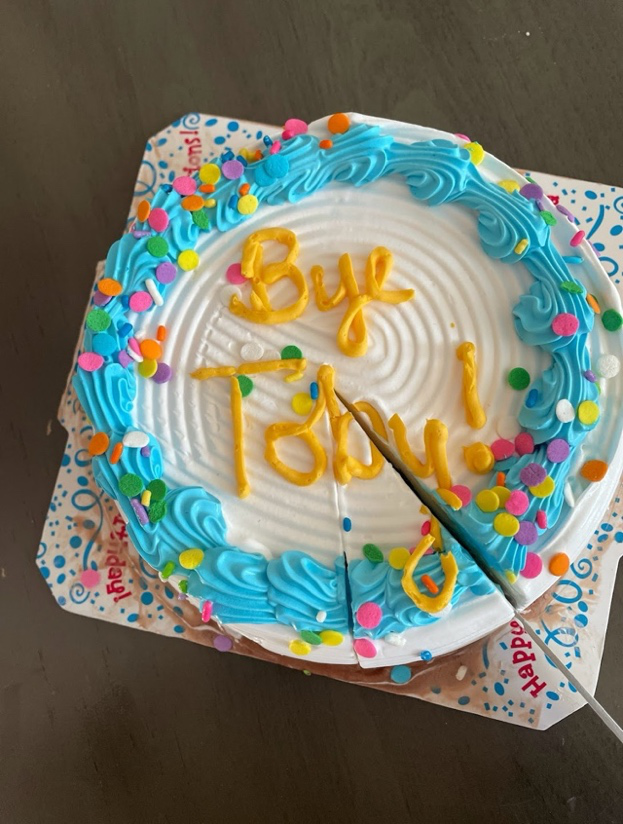
Radiation treatment felt like a huge milestone, and I sincerely hope that it will be the last gasp of the actively growing tumor. I know my recovery journey isn’t over, but I’m a firm believer in celebrating milestones. So on the day of my procedure, I bought myself an ice cream cake and sliced right through Toby’s center:”


 The "Lucky" Brain Tumor
Leave a reply to Emily Cancel reply