
I absolutely love theatre. I am pretty sure it is all my mom’s fault. She was a big fan of the arts and loved to take us to different shows. I remember attending my first Broadway style production when I was ten years old, The Phantom of the Opera. When the chandelier fell at the beginning of the show, I was hooked. Since then, I have had the good fortune to enjoy a wide variety of types of performances.
When I lost all my hearing in one ear at age 27 due to an acoustic neuroma brain tumor, it fundamentally altered my relationship to theatre. Suddenly something I loved became draining and hard work. I didn’t want to give up one of my favorite things, so I went on the hunt for options to make it work.
First, I tried out the telecoil function in my hearing aid. I have a bone anchored hearing device, and when my audiologist was showing me the ropes on the device, she explained I could use my device to link into the sound system of certain venues. This essentially gave me the option to have the sound from the microphone transmitted to my aid to help me hear. In order to do this the venue has to have a hearing loop and your hearing device needs to have a telecoil. I am fortunate that my home state of Wisconsin has tons of venues offering hearing loops, including but not limited to: theatres, churches, auditoriums, hospitals, and even libraries.
My first theatrical experience of using my telecoil was at a Shakespearean play at a great little outdoor theatre, American Players Theatre. I could hear every word so clearly. My hearing husband would occasionally say, “What?” While I caught every word perfectly from the hearing loop system. It is almost as if the actors were speaking directly into my ear.
However, when I tried to use the hearing loop when I attended a musical at The Fireside Theatre, I found that it was not a good experience. Because both vocals and accompaniment were sent across the sound system, the music sent straight to my device was so incredibly loud that I found it uncomfortable. Also, with music and vocals I often struggle to separate the sounds, with everything blurring together. The hearing loop did not solve this issue. It increased the volume and not the clarity. My hearing is such that I did not need any additional volume for the music.
I experimented more to try and make musicals more accessible for me. I tried listening to the soundtrack in advance to familiarize myself with a new show. I read the lyrics to the songs on my way to the theatre so I could hopefully follow along. I even went so far as to make my own captions by copying and pasting all the lyrics from every song in the show into a document on my phone and then put the document into dark mode so I didn’t disturb my neighbors.
However, my next opportunity came by chance. I was attending a musical at the Fox Valley Performing Arts Center and I realized they had a caption bar which I could read from my balcony seats. This was a game changer, as captions were really what I needed to be able to enjoy the show. I learned they offered caption bars at certain performances, and then they added in GalaPro captioning for all performances of Broadway Shows. GalaPro captioning is captions on a mobile device instead of a large bar or screen.
From that point on, my preference has been to see shows with captions whenever possible. However, one of the theatres I had liked to patronize, The Overture Center in Madison, did not offer any captions. I recently worked with them to get a captioning system up and running. They now have a caption screen with seating in the orchestra area to see the open captions as well as the faces of the actors. Captions are offered for specific performances, and the seats are at an accessible cost. You can sit with your hearing companions as well.
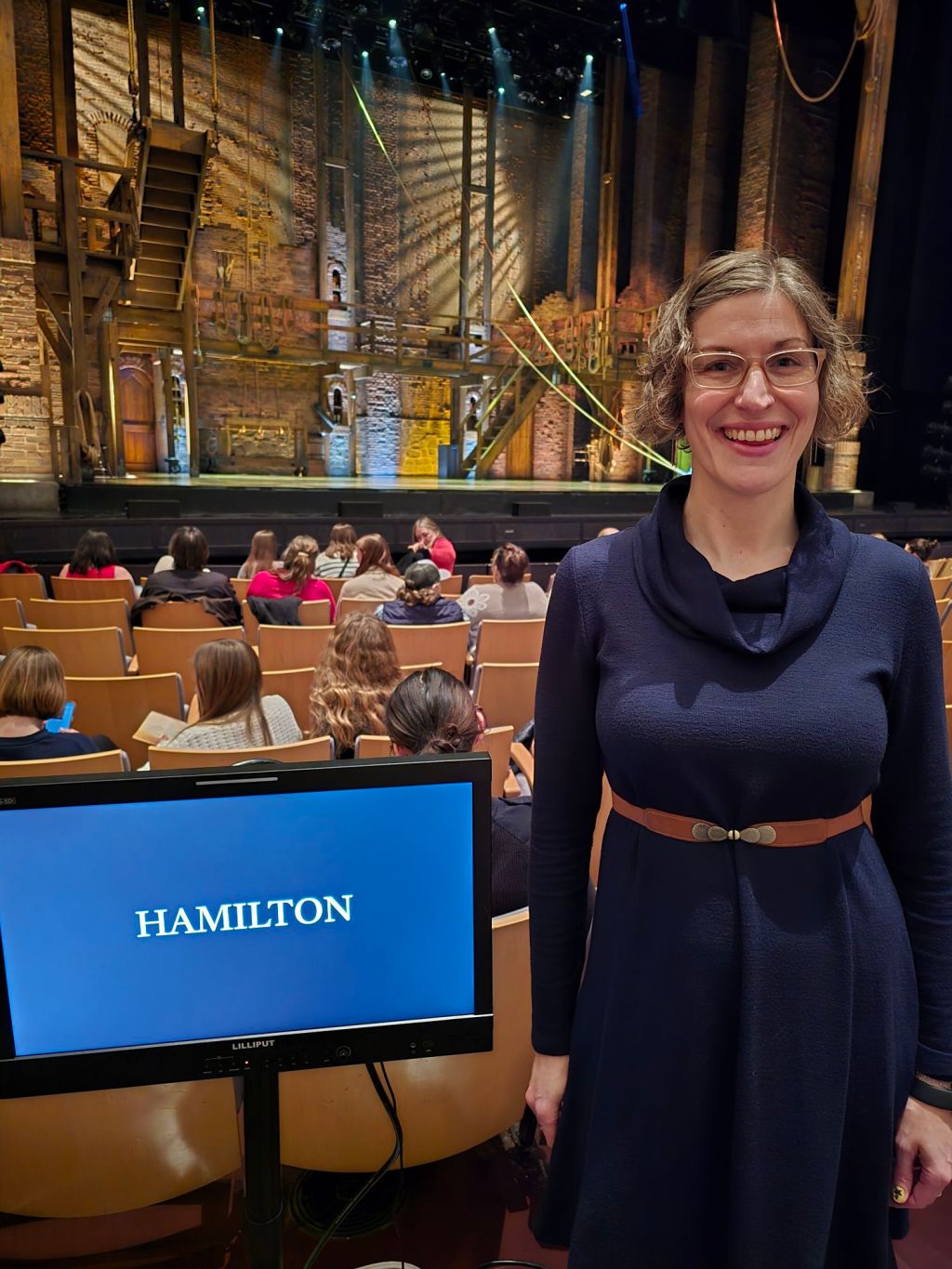
I was recently able to take advantage of the open captions at the Overture Center to see a performance of Hamilton. I truly cannot think of a better show to have captions for, as Hamilton is extremely fast paced with rap-like songs going through lyrics quickly. The opportunity to have captions to see this show made all the difference for my ability to comprehend the musical.
I quite enjoyed that the caption seats essentially created a little island of people with hearing loss. I got to chat with people I knew in the hearing loss community as well as make new connections. Someone thanked me for my role in helping to get captions at the Overture, which meant a lot to me.
It was an extra special evening at Hamilton as we were celebrating my eldest child’s birthday. During the show, I looked over and saw her face glowing with joy as she enjoyed the performance. I thought to myself how grateful I was that I was able to get accommodations to fully participate in this moment with my child. I didn’t have to wonder why everyone was laughing, or feel frustrated that I was missing parts of the story because I was struggling to understand. I am so grateful to be able to share my joy of theatre with my child, like my mom did with me, and that I did not have to sacrifice this delight because I lost my hearing.

 The "Lucky" Brain Tumor
Leave a comment