
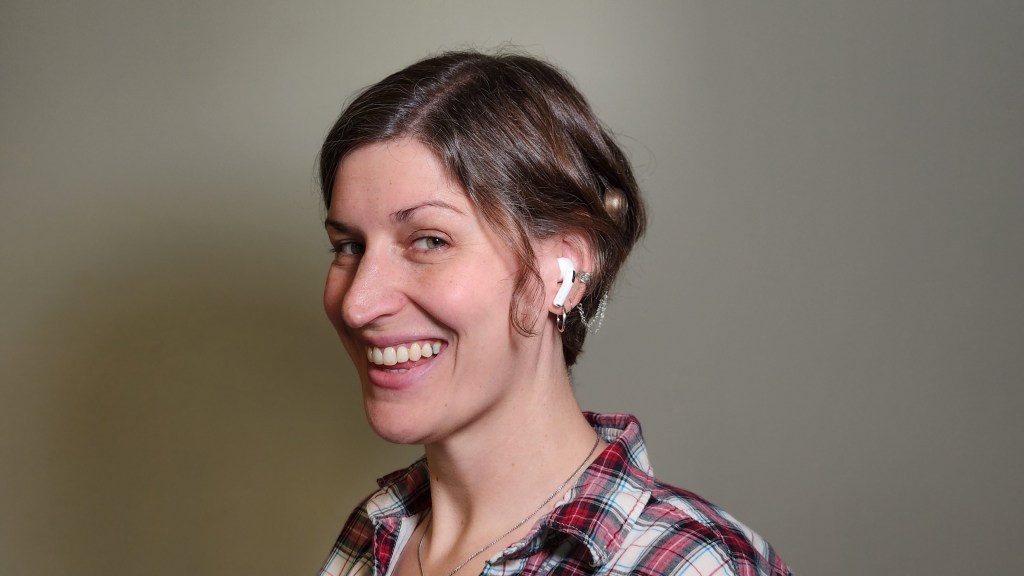
There has been a lot of excitement for Apple’s new software that turns Airpods Pro 2 into an over the counter hearing aid. I was enthused just because it is a big step in breaking down negative stigmas regarding hearing aids- so many people already have AirPods in their ears. I had the opportunity to test out the hearing aid feature, and I am genuinely excited for myself as well as all of my single sided deaf community. The Airpods Pro 2 hearing aid functionality is the best non-prescription solution I have found for background noise.
This is huge, as background noise is the nemesis of all those with hearing loss. For people with single side deafness, often background noise is where they feel their hearing loss, while in quiet situations, they can hear well. In the scheme of hearing solutions, AirPods Pro 2 are reasonably priced and something that isn’t too challenging to set up. A huge help for hearing in background noise has finally become accessible. Also, hopefully, we keep building on the momentum that Apple has created with this excellent background noise technology.
I tested the AirPods in a noisy restaurant environment I often find challenging. I found the noise canceling features really did a good job of toning down the loud music, as well as the general conversation hubbub. That alone made the situation less fatiguing. Then, the conversation boost setting and prioritizing bright sounds helped make my husband’s voice more crisp and stand out above the background noise. It made a much better signal to noise ratio. Compared to other solutions I have tried, it did a better job of removing background noise and making the conversational partner’s voice distinct. It also did not have a lag time, which I previously experienced with the HeardThat app that also removes background noise.
I do feel like wearing AirPods in a restaurant is not at all awkward or uncomfortable. I will just note that chewing is loud, though with the converstaion awareness setting, it has the ability to lower other sounds when someone starts talking. So if my husband started speaking, the chewing sound was lessoned so I could still hear him.
I also tested it at a family birthday party. At that event, it still helped a lot, but it really rocked a restaurant setting. The conversation boost setting points the microphone forward, so it prioritizes the sound in front of you. That works really well when you are sitting across a table from your conversational partner. When you are standing in a circle of 6 people taking turns talking, it helps, but it isn’t able to be quite as effective at isolating the sound.
The hearing aid functionality does not have cros type functionality. What I mean by that is that there is not the ability to have sound get picked up by the AirPod on the deaf side and sent over to the hearing side. So AirPods do not solve the issue of the deaf cone where someone can stand on your deaf side and you will not hear them speaking at all. The deaf side is still deaf. I have a bone anchored hearing aid so I could wear my aid and the AirPods in order to hear on my deaf side and have the noise canceling and conversation boost. It worked really elegantly in my situation. Of course, with cros hearing aids you would have to pick if you wanted to use the cros aids or the AirPods.
You also need to wear both AirPods for the functionality to work correctly. Even with only hearing the sound with one ear. The AirPods needs both microphones picking up sound. It doesn’t even allow you to change the hearing mode with only one AirPod in.
The hearing aid functionality does include hearing protection. I am very excited for more options for protecting my hearing but staying engaged. According to Apple, Transparency Mode (which is where the hearing aid functions are used) has 11-15 dB of sound reduction, Adaptive Mode has 25-29 dB of sound reduction, and Noise Canceling has 25-30 dB of sound reduction. My Loop Experience ear plugs I commonly use have a 20dB sound reduction, for comparison. The AirPods have a very useful amount of hearing protection.
In order to set up the hearing aid functionality, you need to connect your AirPods to an Apple device with a new enough operating system. I am an Android user and pretty much illiterate in Apple. You do not need to have the AirPods pro hooked to an Apple device to use the hearing aid feature after you set it up on an Apple device, but you do have to have them paired to a phone for the hearing aid feature to work. I paired mine with an Ipad we have at work to set up the hearing aid features, and since them have used it with my Android phone connected. You can also set up the hearing aid features for multiple AirPods/ users on the same Apple device.
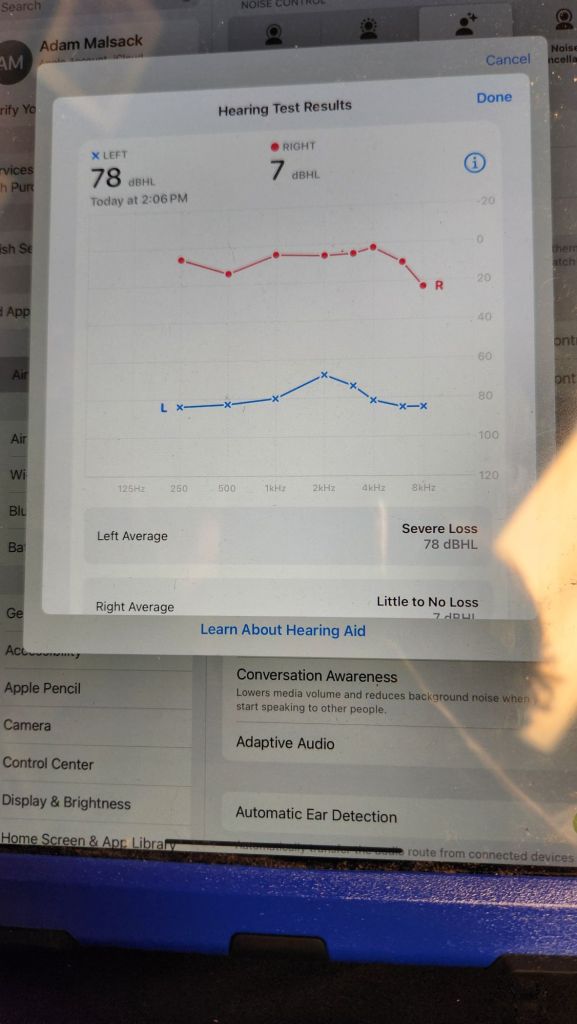
Once you’ve connected and you have the right updated software, you start by taking a hearing test. That functionality alone is useful. It matched my recent audiologist hearing test reasonably well. It won’t let you utilize the hearing aid function until you take a hearing test through it or upload your audiogram.

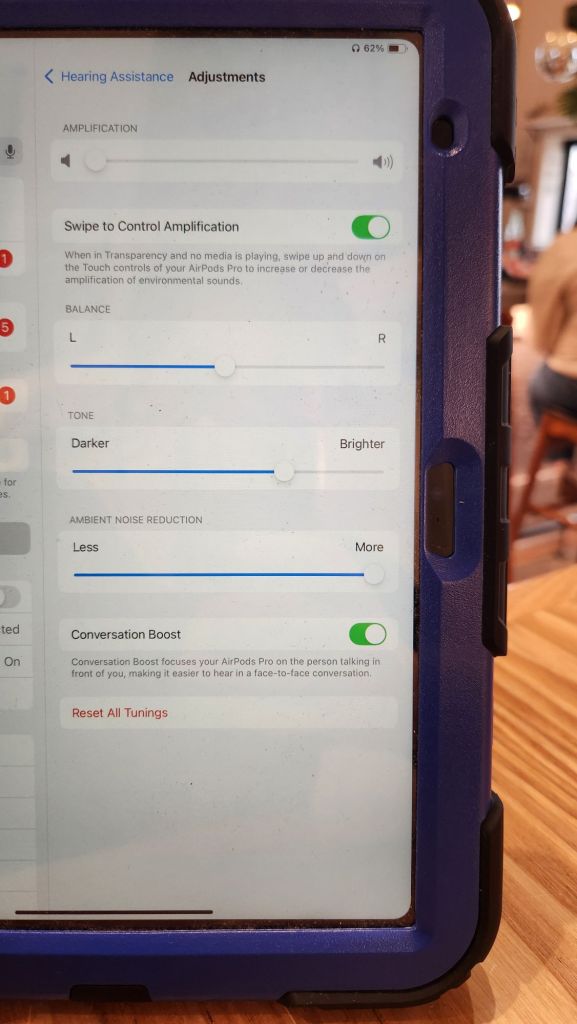
After you take the hearing test, you can turn on the hearing aid feature. Once it is on, it lets you customize the settings as you would like. I personally recommend conversation boost for background noise situations. It has the microphones point forward only to maximize your hearing’s focus on what you are looking at. I also prefer brighter than darker sound, as I feel it helps make the words much more crisp. You can control how much ambient noise you want, I like the ambient noise reduction all the way up. The left to right balance does nothing for those with single sided hearing, as far as I could test. I also like conversational awareness on, as I feel it helped with how loud my voice came through the AirPods as well as things like chewing noises when others spoke.
You won’t be able to wear AirPods all day, as their charge only lasts 4-6 hours, though they do charge quickly in the case. Also, likely your ears would get sore after a few hours. However, for specific challenging situations like lunch at a loud restaurant or even making it through a chaotic family holiday, these may make a huge difference on your hearing fatigue as well as how much conversation you miss. I don’t believe these necessarily replace the role of prescription hearing aids, but if you just want an incidental or inexpensive solution, I think these are just the ticket. I really love how I can combine them with my bone anchored hearing aid for maximum success.


 The "Lucky" Brain Tumor
Leave a reply to Isa Asudeh Cancel reply